by Cody Goodfellow
Thirteen years ago, I wrote my first novel. It was a masterpiece. All my friends said so. But I couldn’t get any publishers to accept it. Or reject it. Or read it. Or reply to my query letters.
“Fuck ‘em, dude,” my best friend said, “let’s put it out ourselves.”
Anyone who’s ever broken stuff they cared about while throwing a temper tantrum should see that it seemed like a good idea at the time.
Back in 1998, self-publishing wasn’t even a dirty word, or the expensive method of career suicide that it would soon become, let alone a viable business model. But when my excellent friend Adam Barnes suggested that we set up a publishing company to put out my epic first novel, then still in progress, as a pair, if not a trilogy, and market them ourselves, it was far from the dumbest idea I was willing to say yes to. I had nothing to lose.
For several years, I’d tried and failed to sell my short fiction. I didn’t have internet access, and used the Writer’s Market to find listings. Most of the markets I subbed to were gone by the time they got my manuscripts, and the rest were content to send back earnest, if contemptuous, critiques that seemed to be about someone else’s work altogether. The notion that my work was still raw and yet already rotten had occurred to me, but my solution was to bypass the little leagues and try to write a gigantic motherfucker of a novel that paid back all my influences while fusing them into something new. I was crazy in love with Lovecraft’s Cthulhu Mythos, but instead of copying his antiquated approach, I wanted to modernize it and use the kind of genre-mashing techniques Lovecraft pioneered to make cosmic horror relevant and scary again. I had reached the point where I needed to know, if I did exactly what I wanted to do with my writing, would anyone want to read it?
I didn’t know anybody in the field, and had only sold work to a roleplaying game company (who would not put it out for another decade) and Substance, a CD-ROM magazine founded by college friends who earned write-ups in Mondo 2000, Spin and Playboy, then just as quickly ran their innovative new media miracle into the ground.
I didn’t know anybody, I didn’t trust anybody, and I didn’t believe that my work would get a fair reading at any of the New York publishers. If I couldn’t make anybody read my short stories, what chance at a fair hearing did I have with a novel? So self-publishing seemed like the only viable alternative. And anyway, it wasn’t really self-publishing… my lawyer was doing it.
It seemed like a brilliant solution. We would put out exactly the book I wanted, and I would know if I was destined to write for a living, or to run a children’s shoe store.
I had just finished writing Radiant Dawn when Adam hit me with his idea. He had moved up to Seattle after college to become a probate attorney, while I went back to San Diego to work at a B&N, start a family and slowly sink into a slough of despond. While neither of us had any publishing experience, Adam and I shared a nuclear contempt for 99.9% of everything, so when he told me he’d be willing to partner up with me to put out the book and its inevitable sequel, I thought we had an unbeatable plan. I would make them wish they’d exploited me when they had the chance.
We proofed and formatted the manuscript ourselves. I did the cover design and had my friend Scott Riggs slap it together in Photoshop. We found a good offset printer and Adam put up the funds to print 2500 copies. We weren’t sure it would be enough.
The results were… discouraging.
Adam submitted the book to Ingram and Baker & Taylor, only to find they had a Byzantine approval regimen that kept us sending review copies and waiting to hear nothing, because they kept replacing each rep we dealt with, paying them in a generous severance package of wagonloads of unread book submissions.
Getting reviews was even tougher. My hometown paper sent a withering gob of condescension and sold my review copy to a local used bookstore, which sold it back to me for a buck. To get Cinescape Online to review it, I had to agree to review a shitty X-Files ripoff called Freakylinks, which mercifully got cancelled after five episodes.
But even more maddening were the rarefied specks of encouragement that kept us struggling. We didn’t know any famous horror or sci-fi writers to tap for a blurb, but through a lucky chain of acquaintances, we managed to get the book in front of Jack Olson, the “dean of true crime writers.” With nothing to recommend us and no reason to spend his precious time reading my grotty manuscript (he died only two years later), he not only read the book, but surpassed our wildest dreams of hubris with the kind of praise that should’ve cracked the heavens and made it rain sales.
Adam entered the book in a competition that looked at all small press works, some 80% of which were nonfiction memoirs and how-to books. The judges mostly gave it high marks and one of them loved it, but one clown trolled it to death, even on criteria for which a novel should’ve been excused. On the back of her form, she added the comment “derivative pseudo-sci-fi” by way of explanation. Adam assured me this was exactly the kind of hate we should be hoping for. The Edsel failed because nobody particularly loved or hated it, at first. A polarized reaction like this was exactly what we needed.
As much shit as we all love to throw at the corporate big box stores, the B&N I worked at gave me more love and support than I deserved. The first articulate, glowing review on Amazon of RD1 was written by an assistant manager, and my boss Pat Gasior ordered a box for the store and let me do a reading on a Saturday night.
It was a triumph. All my friends and family turned out, and because I was in the middle of the store shouting out profane body horror nonsense, a huge crowd had gathered by the time I was done. A fistfight almost broke out when some guy started screaming at me about all the F-bombs I dropped, and people who didn’t even hear the reading came over and bought copies, just to piss the idiot off.
We thought we won.
When reviews finally began to come in a year after we needed them, they gave the worst kind of praise. A guy at Talebones had doubted the book would be worth his time, but then admitted it was better than most of the mainstream stuff he’d read lately. His only gripe was that the book ended in a cliffhanger and promised the sequel in 2000, which by then had come and gone. Where was the sequel?
Our flawless business model had always decreed that we would finance the second book with the revenues from the first, right after we each got a flying hot tub limousine. By then, I had begun RD2, but neither of us could convince our wives that the best way to detonate our unexploded bomb would be with another, bigger bomb. Adam had put up the money for RD1 and his garage was now the Perilous Press fulfillment annex. It was my turn to pony up for printing.
Thanks to internet-based research, RD2 was almost twice as long as RD1, but the real reason was that I was more or less sure by then it would be the last book I’d ever write. Nobody knew who I was, nobody cared, and the people closest to me were only suffering for my delusions of grandeur. I had to put it all down for one last spin and assure myself that I’d left no turn unstoned before I retired to a life of seriously bitter retail mismanagement.
The freight company delivered RD2 to my parent’s semirural hilltop compound in Lakeside in Summer 2003, and we stomped black widows and baby scorpions to stack the cartons into a rusty cargo container just like the one Storch escaped from in the first book, now christened the Perilous Fullfillment Annex II.
The second book got half as many reviews as the first. What the hell was wrong with the reading public? Our books were awesome, and they were clearly worlds away from the iUniverse and Publish America shit that was starting to show up everywhere.
With no other options, I started to look seriously at the possibility that it wasn’t the rest of the world fucking up my program. All along, it had been my friends who had believed in me and supported my crazy dreams. To get this shit to go over, I simply had to make more friends.
I also started to realize that maybe I should learn to write short stories. I signed up for a UCSD Extension class taught by the inimitable Nancy Holder. I learned the basic elements of a working short story and wrote a bunch of stuff in that class that I immediately sold to magazines. I also made friends like Eunice Magill, a feisty badass middle school teacher who convinced me to attend World Horror in Phoenix in 2004.
There, I met John Skipp and gave him a copy of a chapbook novella prequel to Radiant Dawn that made him my slave. I also met Carlton Mellick III, Rose O’Keefe, Jeremy Robert Johnson, and Jason from Night Shade, as well as a horde of folks who were trying to do what we were doing, without blowing as much of their own money as we had.
Every book on writing assures you that professionals don’t rely on friends for criticism, and common sense wisdom warns against doing business with friends, if you want to stay friends. But my friends have given me the strength to keep at it until I was able to convince people who weren’t my friends that my work wasn’t a waste of their time. Skipp was moved to write a huge, slap-happy alert to the world that my shit was ripe and red hot. It ran in Cemetery Dance alongside “Burning Names,” a story I’d written in Nancy’s class. Like a molasses glacier moving uphill, we finally began to make progress.
We had never intended to use Perilous purely as a vanity press, but we never recouped our initial investment, so the company kind of drifted like a spent booster module until a few years ago, when we hooked up with S.T. Joshi and set out to revive the press as a vendor of other people’s works.
Our focus was to be modern cosmic horror. Lovecraft in his day was a true Bizarro godfather: a self-taught eccentric who acquired only a scattered cult of followers in his lifetime. His best work turned horror on its head, replacing the supernatural with sci-fi materialism, trashing outmoded concepts of good and evil and demoting humanity to its proper place in an infinite, uncaring universe. The pulp markets barely kept him in navy beans, and he died at 47 from undiagnosed bowel cancer, long before his young friend August Derleth founded Arkham House to publish his work.
While the Cthulhu Mythos has exploded into a plethora of cults and sub-cultures, it still lurks well out of the mainstream, less a stylistic contrivance than a mass mental illness that even sane, talented professional writers cannot resist indulging. More confrontational and confounding at its best than mainstream horror, modern Mythos fiction strives for a chilling atmosphere of pervasive weirdness, instead of cathartic gross-outs or reactionary doses of poetic justice, and so is a closer cousin to Bizarro than almost anything else out there.
We’ve put out fancy limited yet affordable illustrated hardcover editions by Michael Shea and Brian Stableford, but taking a page from the Eraserhead Press model, we’ve also started to do slim POD paperbacks. It’s no more of a business winner than when I put out my own shit, but we’ve come to realize writing and publishing books is no more a rational choice than reading, and yet we’re powerless to stop. We’re committed to losing money making the kind of things we’d love to read, rather than trying to make something just to sell it.
We get fewer submissions than any other small press, and we put out fewer releases than any publisher that hasn’t died (well, twice as many as Swallowdown last year). But we love what we do, and we love the friends who’ve enabled us to do it.
In spite of everything, God damn it, we’re winning.
—
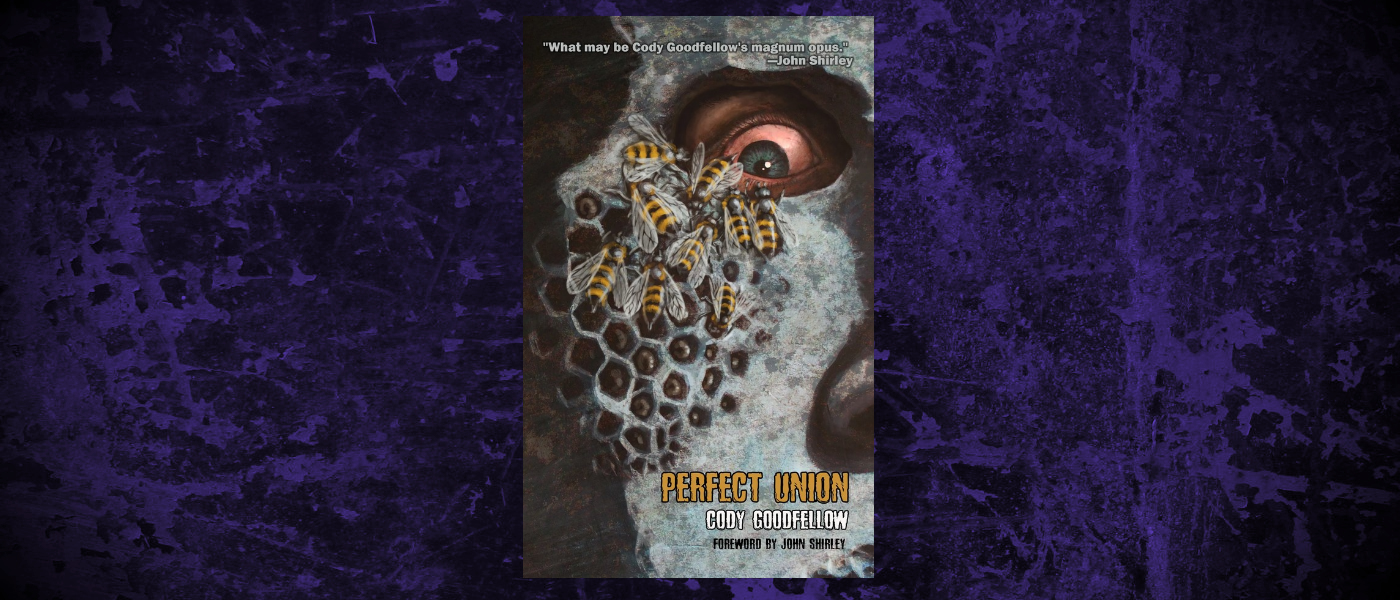
Cody Goodfellow is the Wonderland Book Award-winning author of Perfect Union, Silent Weapons for Quiet Wars, Radiant Dawn, Ravenous Dusk, Spore and Jake’s Wake (both with John Skipp), and All Monster Action! (forthcoming from Swallowdown Press). His short stories have appeared in many anthologies and magazines, including The Best Horror of the Year Volume Three, G.I. Joe: Tales from the Cobra Wars, Classics Mutilated, The Bizarro Starter Kit (Purple), and Cemetery Dance.